Fabrizio Del Maffeo: Building Europe’s Edge AI Champion
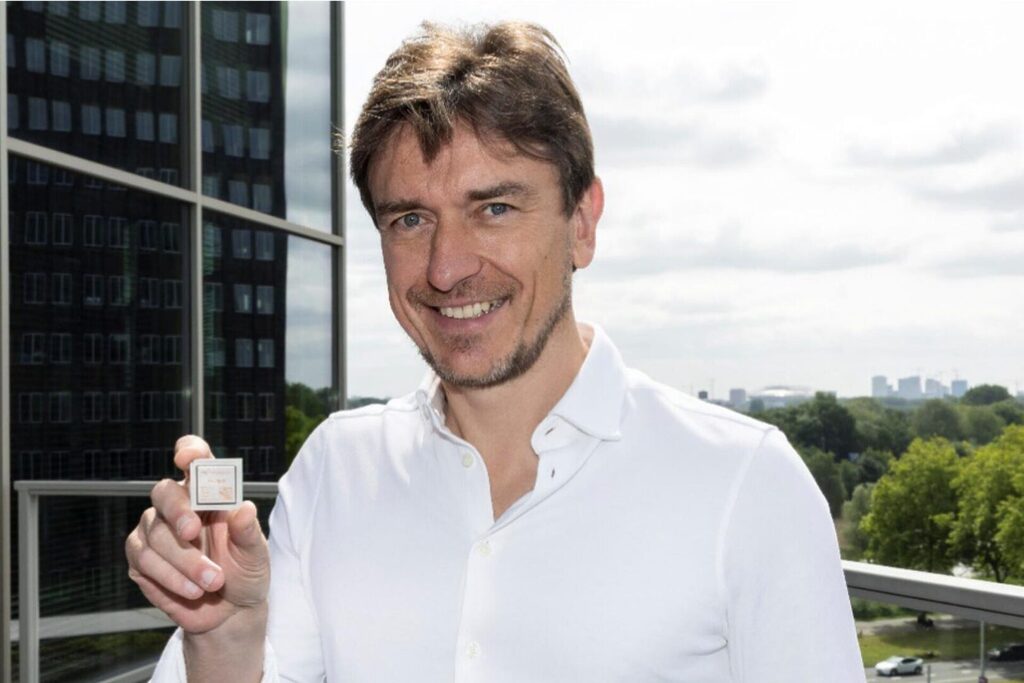
“For companies to truly succeed, we must refuse to think of ourselves as European players only.”
— Fabrizio Del Maffeo, Axelera AI
Europe’s deep tech ecosystem is entering a defining decade — and few companies embody that momentum more powerfully than Axelera AI.
From its headquarters in Eindhoven to deployments across industrial manufacturing, robotics, retail, agritech and public safety, Axelera AI has rapidly emerged as one of Europe’s most compelling AI infrastructure champions. In just a few years, the company has rewritten expectations for what a European semiconductor scale-up can achieve: shipping to hundreds of customers globally, pioneering breakthrough edge AI architecture, and securing the largest funding round ever raised by an EU AI semiconductor company — a landmark €211 million Series C that propelled Axelera AI into unicorn territory.
At the centre of this extraordinary rise is Fabrizio Del Maffeo — entrepreneur, engineer and visionary co-founder whose ambition for Europe’s technological sovereignty is matched only by his relentless execution. Before launching Axelera AI, Del Maffeo led AI initiatives at Bitfury Group and held leadership roles within the ASUS ecosystem, experiences that helped shape his conviction that the future of artificial intelligence would depend not only on software, but on radically more efficient computing infrastructure.
Axelera AI’s journey also stands as one of the defining success stories of the EIC Scaling Club — the European Innovation Council-backed community bringing together Europe’s most promising deep tech scale-ups, investors, corporates and innovation leaders to accelerate the continent’s next generation of global champions. Designed to help Europe’s breakthrough companies scale faster and compete globally, the Club’s mission is already being validated through companies like Axelera AI: ambitious, science-led and globally relevant.
In this conversation, Fabrizio reflects on building a category-defining AI company in Europe, the strategic importance of edge AI, the realities of scaling deep tech globally, and why Europe’s next industrial revolution will be powered by founders bold enough to think beyond the status quo.
TT: Axelera AI recently raised over €200 million — what does this enable you to do next?
FDM: The funding enables Axelera AI to scale operations further, expand its sales team, strengthen customer support, and complete its product roadmap. Crucially, this round attracted global investors — including American ones — which further validates the company’s international standing. But beyond the operational priorities, the capital is being deployed in service of a larger ambition: building what I like to describe as ‘a generational company,’ rather than a startup designed simply to create value and disappear. With more than 500 customers already in hand, and a growth rate of around 50 new customers per month, the focus is on deepening that leadership position and cementing Axelera AI as the defining player in Edge AI semiconductors.
TT: How have the EIC Scaling Club and the Tech Tour community supported your success?
FDM: The EIC Scaling Club has given us the visibility and exposure within a broader ecosystem – which goes far beyond only Europe, and far beyond the deep tech market. Visibility within the general financial and technology market is necessary for a scale-up like Axelera AI, because we are preparing toward our IPO round. Thanks to the EIC Scaling Club and all the support we have, we got the necessary exposure to make a broader audience aware that Axelera exists, boosting the impact that we have in Europe, as well as globally.
Furthermore, the Club has also helped us through different events to connect with corporates, which in Europe are typically not willing to allocate the time and resources to speak to startups. They tend to be risk-averse, but the EIC Scaling Club and Tech Tour have allowed us to get this exposure.
Last but not least, Tech Tour gives us the chance to have valuable conversations with key decision-makers, with experienced entrepreneurs, with seasoned experts in technology and investment. This has allowed a company like us to reflect on the decisions we are taking, reflect on our direction, and get the kind of mentorship which is necessary always for any CEO. I mean, it doesn’t matter where you are in your path – it is very important to have this sounding board around you, a dynamic sounding board which evolves together with the company, at every different stage – and Tech Tour has provided this for us.
TT: Can Europe realistically compete with the US and Asia in AI and semiconductors — what’s missing today?
FDM: Yes, but it requires a fundamentally global mindset from day one. Building in Europe is difficult as there are different laws and regulations across the countries that comprise the continent.
Further, countries like the United States are more risk-tolerant in adoption technology than European governments. So, for companies to truly succeed, we must refuse to think of ourselves as European players only.
The talent and technology exist within Europe to produce global winners, but Europe still lags risk capital for scaleups, necessary to scale companies to global champions.
Last but not least, Europe needs to generate demands with pre-commercial agreements, like United States have been doing with NASA and DARPA.
This will compensate partially the risk-aversion of large European companies which don’t adopt new technologies until their full maturity.
TT: You focus on edge AI — why is that the future, over centralized AI?
FDM: Transformative technologies begin centralized, then decentralize as they mature and become affordable. Railways gave way to cars. Central power stations gave way to local energy generation. Mainframes gave way to personal computers. AI is now on the same trajectory. Centralized AI made sense when computing power was scarce and costs were high, but with technology like Axelera’s, that equation is changing. Edge AI allows intelligence to run locally, inside the device itself, close to where data is created. This matters not just for cost, but for safety, latency, and sovereignty. In automotive, robotics, drones, and other critical applications, you cannot afford to wait for the cloud to respond. Intelligence must be local, immediate, and controllable.
TT: Axelera AI already serves 500+ customers — what’s been the key to achieving that traction so quickly?
FDM: First, the technology itself is competitive on its own merits — Axelera did not grow by being a European alternative, but by delivering hardware and software that works better, and more economically, than existing solutions. Second, timing: the broader AI market has matured. Newer neural network models generalize far better than earlier generations, which means deployments that once failed are now becoming viable. Many industries that struggled with proof-of-concept are now ready to scale, and Axelera’s edge-native approach solves the core problem that held them back: cost and complexity at scale. Third, we have a core belief that anyone wanting to bring the benefits of AI into their environments should be able to; we work to actively democratize the technology’s availability. We work with customers everywhere, not just in our home market, which has accelerated that customer base significantly.
TT: What’s been the hardest part of scaling a deep tech company in Europe?
FDM: Building a company in Europe is very difficult, especially in a capital-intensive industry like semiconductors, with very long time to profitability. Access to investment within Europe alone will not suffice to build a world-leading company, which is why we diversify our investor base around the globe. The other difficult part of scaling in Europe is to find first adopters: large European companies are risk-adverse and they don’t adopt new technologies until their maturity.
TT: How do you balance rapid growth with solving big challenges, like energy use and data sovereignty?
FDM: Our technology is extremely energy-efficient and scales very well. After launching 2 products – Metis and Europa – which address the need of computing in edge devices and enterprise servers, we are now working on Titania, a pure server-class AI accelerator which will deliver high performance at a fraction of the power consumption and cost, compared to any existing chip. Titania will solve the energy challenge with a power consumption 3-4x lower than an Nvidia solution, and it can be deployed anywhere, from data center to enterprise, in line with the growing need of data sovereignty.
___
Axelera AI’s trajectory is more than a company success story. Indeed, it is a signal of Europe’s growing confidence and capability in deep tech leadership. In an era where artificial intelligence infrastructure will shape economic competitiveness, security and industrial resilience, companies like Axelera AI are proving that Europe is capable of more than just articipating in the global AI race: Europe and its entrepreneurs are capable of leading it.
For the EIC Scaling Club community, Fabrizio Del Maffeo’s journey captures exactly what the initiative was created to enable — transforming breakthrough European innovation into globally-scaled impact. Through bold vision, strategic capital, world-class talent and ecosystem collaboration, Axelera AI has become a benchmark for what Europe’s next generation of deep tech champions can achieve.
As Europe continues to invest in its innovation sovereignty and entrepreneurial ambition, one thing is increasingly clear: the continent’s future unicorns will not simply emerge from ideas alone, but from founders who can turn scientific excellence into industrial scale. Fabrizio Del Maffeo and Axelera AI are already showing the way.
Want to stay in the loop for more inspiring conversations? Sign up for our newsletter below!
Newsletter
Stay up to date with market insights, trailblazing investment cases, and leadership profiles by subscribing to our newsletter.