Rotonium: Bringing Room-Temperature Quantum Acceleration to the Edge
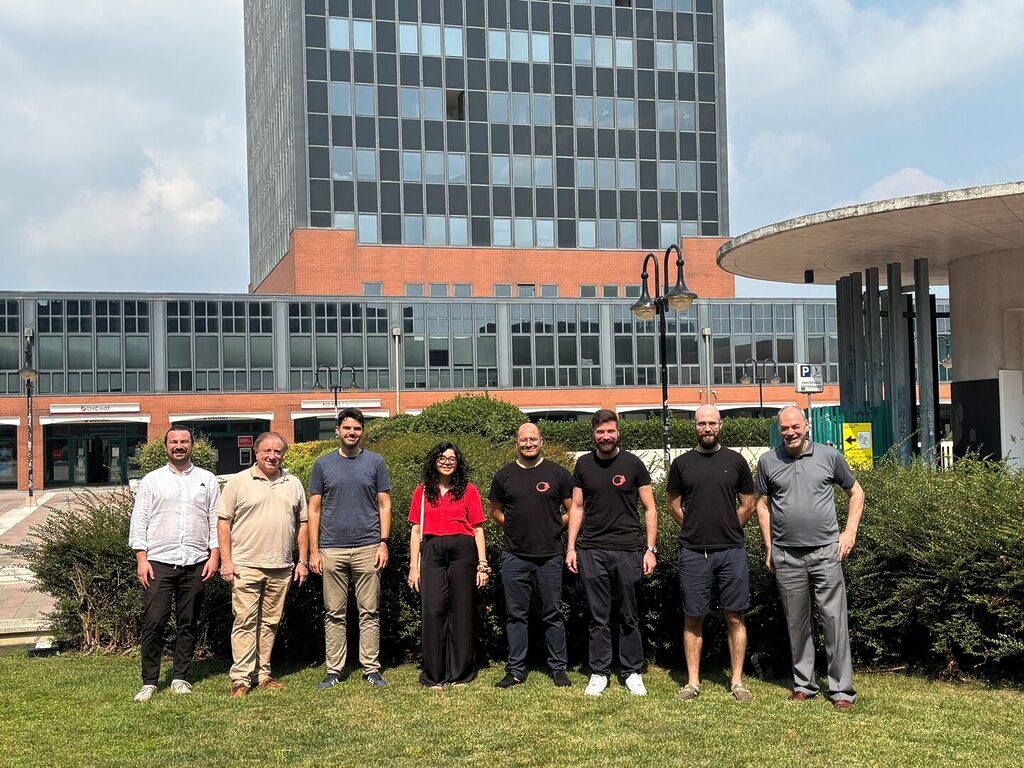
Rotonium, an Italian deep-tech startup, is on a mission to take quantum computing out of the data centre and put it where the real world needs it. As a member of the PhotonHub Scaling Club, the company is developing miniaturized, room-temperature photonic quantum processors (QPUs) for edge and industrial applications — headquartered in Friuli, with an operational and R&D site in Padua.
Founded by industrial entrepreneur Roberto Siagri and astrophysicist Fabrizio Tamburini, Rotonium combines industrial execution with frontier research in structured light and photonic quantum computing.
Roberto Siagri, CEO of Rotonium, shared the company’s vision: “Rotonium is not trying to make quantum computing bigger and more centralized. We are building the technology to make it smaller, modular, protected and deployable.”
Siagri brings a rare industrial track record to that ambition. Before Rotonium, he co-founded Eurotech, which he led as CEO from startup to IPO and international growth, pioneering embedded computers and edge computing. “With Rotonium, I’m applying the same playbook to quantum,” he said. “Taking a technology out of the lab and putting it where the real world needs it.”
A room-temperature architecture built for the edge
Rotonium develops miniaturized, room-temperature photonic QPUs designed to bring quantum acceleration beyond today’s dedicated, infrastructure-heavy environments. The company does this through a gate-based single photon architecture, encoding quantum information in the internal degrees of freedom of the photon — including orbital angular momentum and polarization — to enable deterministic logic operations in a compact system that operates at room temperature.
“By exploiting multiple degrees of freedom of a single photon, we can reduce circuit complexity and create a practical path towards compact, room-temperature quantum processors,” explained Fabrizio Tamburini, Chief Quantum Officer of Rotonium.
That architecture underpins a clear miniaturization path: desktop QPUs for early validation, PCIe-like QPUs for servers and industrial edge systems, and System-on-Module (SoM) QPUs for autonomous platforms where deployability and strict space, weight and power (SWaP) constraints are critical.
“Our mission is to make quantum acceleration deployable outside today’s dedicated, infrastructure-heavy environments,” explained Siagri, “bringing photonic QPUs closer to where data, decisions and SWaP constraints matter most: from industrial edge systems to defence, space and autonomous platforms.” The company’s secret sauce is its room-temperature photonic architecture, based on qubits encoded in orbital angular momentum and polarization and protected by six patent families.
From technology validation to productization
Rotonium is now at the pre-Series A stage, moving from technology validation toward productization, and has three priorities running in parallel. The first is capital: the company is preparing its Series A round to finance the next phase of hardware development, including the desktop QPU and the PCIe QPU. The second is deepening its technical roadmap around integrated photonic quantum processors, with a focus on miniaturization and deployability. The third is working with selected industrial, defence and space stakeholders to identify the first use cases where quantum acceleration can deliver measurable value under strict SWaP constraints.
The roadmap has clear targets: the desktop QPU in H1 2028, the PCIe QPU in H1 2029, and the SoM QPU in H2 2030. “Strategically, our priority is to validate an edge-first approach to quantum computing,” said Siagri, “starting where deployability matters most, while building a platform that can later scale toward industrial infrastructure, cloud and data-center environments.”
Backed by a protected technology base and proven milestones
In just four years, Rotonium has built a strong multidisciplinary team from scratch — combining expertise in quantum physics, photonics, integrated circuits, algorithms and company building — and developed three generations of photonic integrated circuits (PICs). The first PIC validated the core concept; the second delivered a 4-qubit photonic quantum processor working at room temperature; the third migrated to silicon nitride, the company’s production platform, and integrated the single-photon source.
Alongside that technical progress, the company has built a protected technology base of six patent families around its photonic quantum architecture, and completed both its pre-seed and seed rounds. “We are proud that Rotonium has moved from an initial scientific vision to a credible industrial roadmap for deployable photonic quantum processors,” said Tamburini.
That progress rests on a team designed from day one as a fusion of frontier science and industrial execution. As a fabless company, Rotonium focuses on architecture and IP while developing a network of specialized manufacturing and technology partners — with lessons drawn directly from Siagri’s Eurotech journey, from miniaturization as strategy to fabless discipline and ecosystem-based manufacturing.
PhotonHub Scaling Club: building the ecosystem
For a fabless deep-tech company, the right ecosystem around technology, production and capital is everything — which is exactly why Rotonium joined the PhotonHub Scaling Club.
“We joined with a dual objective: to connect with investors who already understand and invest in photonics, and to identify potential suppliers and manufacturing partners for our photonic processors,” said Siagri. “As a member, we hope to access a strong European network of photonics investors, industrial partners and suppliers that can help us move from technology development toward scalable productization.”
An edge-first vision for quantum computing
Rotonium is built around a distinctive thesis: that quantum computing is still largely in its “mainframe era” — powerful and promising, but tied to dedicated, infrastructure-heavy environments. Meanwhile, after years of cloud-first enthusiasm, an emerging era of autonomy and resilience is bringing more computing power back to the edge, where it must be compact, deployable and SWaP-optimized.
“As happened in classical computing with PCs and later with graphics accelerators, we believe part of the disruption may come from making quantum acceleration smaller, modular and deployable,” said Siagri. Rotonium’s goal is to develop compact, room-temperature photonic QPUs that first serve edge and industrial applications where space, weight and power constraints matter — and later scale toward broader cloud and data-center infrastructure.
Newsletter
Stay up to date with market insights, trailblazing investment cases, and leadership profiles by subscribing to our newsletter.